
Insights & guides
Expats in Spain: the paperwork problem, and how an AI system helps
Moving to Spain is the easy part. Then come the NIE, the TIE, the padrón, the bank, the tax return and letters in administrative Spanish. An AI system will not queue at the extranjería office for you, but it can read every letter in your language, track every expiry date and prepare each procedure, with a human professional where it matters.
The problem: a country that runs on paperwork
Ask any expat in Seville, Málaga or Madrid what was hardest about moving, and the answer is rarely the language or the weather. It is the paperwork.
Each step depends on another one:
- the NIE, your foreigner's identification number, needed for almost everything, from a phone contract to buying a car;
- the TIE, the residence card, with fingerprints taken at an appointment you have to book online, often weeks ahead;
- the empadronamiento at your town hall, which proves where you live and is asked for by many other procedures;
- the Social Security number, a Spanish bank account, a digital certificate to use the online offices;
- and once you are resident, taxes: the income tax return, and for many expats the model 720 declaring assets held abroad.
None of it is impossible. But it is spread across ministries, websites and offices that each have their own rules, their own forms and their own vocabulary.
Where it actually hurts
Talk to expats and the same four problems come back.
1. Letters you do not fully understand. A letter from the Agencia Tributaria, the Seguridad Social or the town hall arrives in formal Spanish. Is it information, a request or a penalty? Is there a deadline? Online translators help with words, not with what the letter means for you.
2. Deadlines that are easy to miss. A TIE to renew, a padrón certificate that is only accepted if recent, the income tax return between April and June, model 720 by 31 March. And notifications sent to the government's electronic mailbox are, if you are registered for them, treated as delivered after ten days, read or not.
3. The wrong document on the day. You finally get an appointment, and the officer asks for a document you did not bring, or a copy instead of the original. The appointment is lost, and the next one is weeks away.
4. Rules that change. Spain closed its golden visa route in April 2025, created a digital nomad visa in 2023, and invoices for autónomos will have to come from certified software from July 2027. What a friend did three years ago may no longer apply.
What an AI system can do about it
By AI system, we mean more than a chatbot. It is a small set of connected tools that work on your own documents, with fixed rules for what matters and your approval before anything is sent. For an expat, four pieces make the difference.
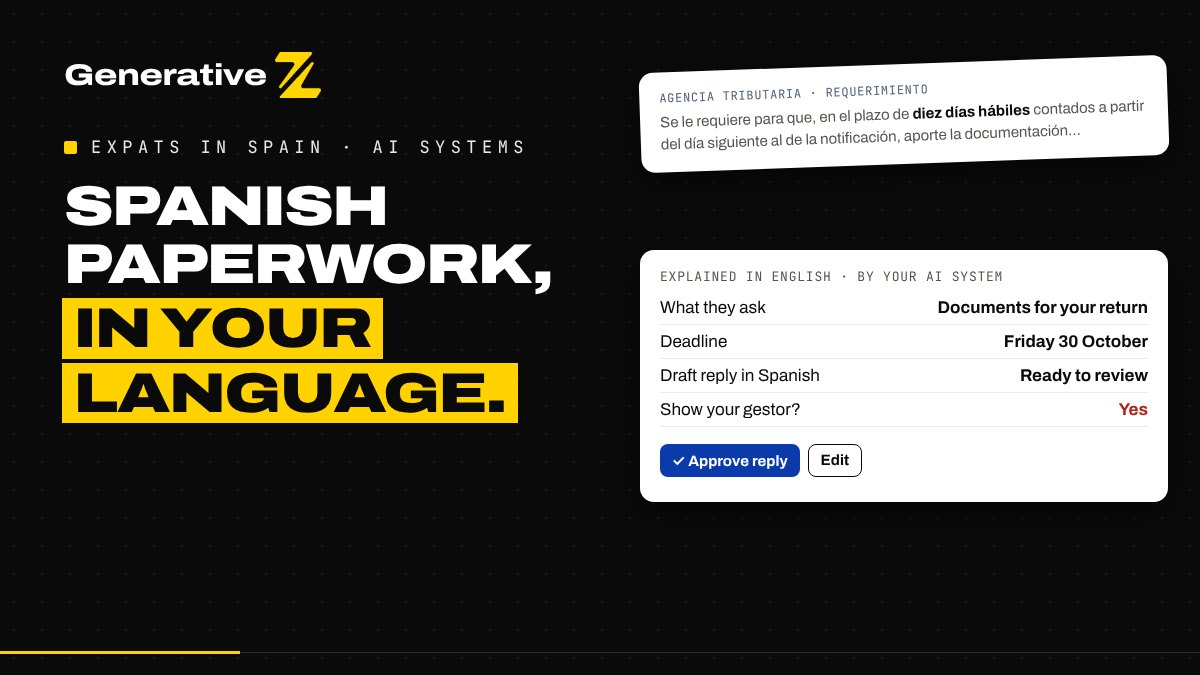
1. A letter reader in your language
You forward the email or take a photo of the letter. The AI reads it and gives you, in English, French or your own language:
- who sent it and what kind of letter it is;
- what is being asked of you, in plain words;
- the deadline, written as a date, not as "ten working days from notification";
- the documents you will probably need;
- a draft answer in correct Spanish, if an answer is needed.
The letter is treated as data, never as instructions, and the system says when it is unsure. When the letter involves money, a penalty or a legal deadline, it tells you to show it to your gestor or lawyer, with a summary ready to forward.
2. A document vault with expiry dates
Your passport, NIE, TIE, padrón certificate, health insurance, rental contract and car documents are stored in your own private folder. The system reads each one, records its expiry date and reminds you weeks before, not the day after.
3. A checklist for each procedure
Before an appointment, you tell the system what it is for: a TIE renewal, a change of address, a driving licence exchange. It prepares the list of documents from the official requirements you give it, checks what you already have in the vault, and lists what is missing or out of date. You arrive with everything, in the right format.
We do not automate appointment booking: an AI system should help you prepare, not compete with other people for scarce slots.
4. Your personal admin calendar
Income tax, model 720 if it applies to you, the IBI on your home, your car's ITV, your contract renewals: one calendar, built from your situation, with a short email when something is coming. If you are an autónomo, it can connect to the Autónomo OS workflow for quotes, invoices and quarterly deadlines.
What it does not replace
An AI system does not give legal or tax advice, does not file anything on your behalf and does not replace a gestor, a lawyer or a sworn translator when one is required. Its job is to make sure you understand what you receive, never miss a date, and arrive prepared, so the time you pay a professional for is spent on real questions.
Your documents are personal data. A well-built system keeps them in your own storage, sends to the AI model only what is needed for each task, and keeps a human, you, in control of every message that leaves.
Build yours, or learn to
Generative Z builds AI systems for people and small businesses in Spain, and teaches expats how to use AI for their own admin.
- In Seville, join our free discovery session on AI for your own tasks: book your place.
- Want a system set up for you, with your documents, your languages and your gestor in the loop? Tell us about your situation and we will map it with you.